
From exhibition floor to long-term positioning
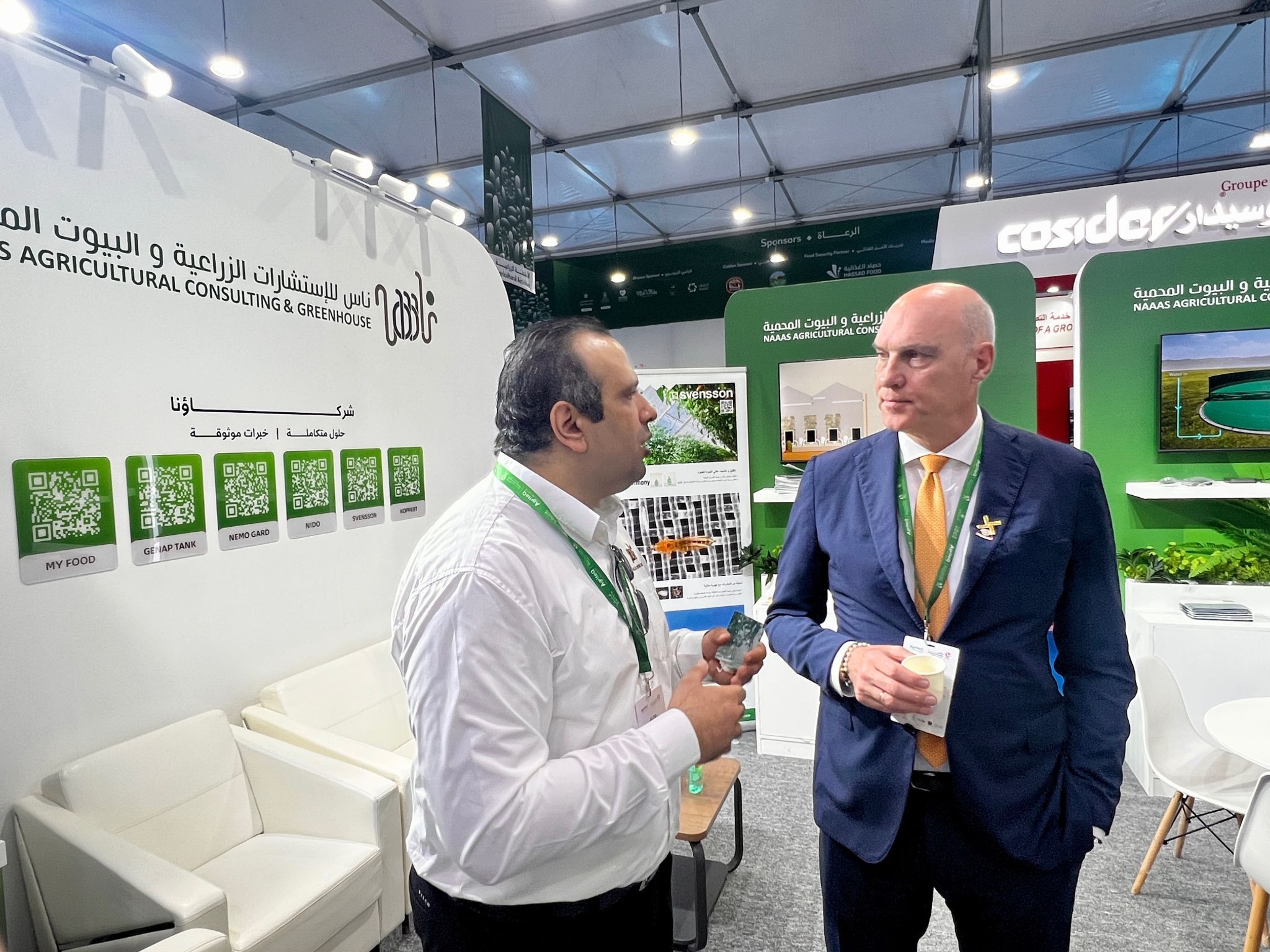
This week, Dutch Greenhouse Delta and its Partners for International Business (PIB) consortium were present at AgriteQ in Doha, Qatar — one of the Gulf region’s leading platforms for agriculture and agri-technology .
But our presence in Qatar goes beyond participation in an exhibition.
It reflects a broader structural shift: capital, ambition and policy focus are increasingly moving toward Asia and the Gulf region . For Dutch horticultural companies, this is not about opportunism — it is about long-term strategic alignment.
Why the Gulf region matters
Across Asia and MENA, discretionary income growth is expected to outpace much of Western Europe in the coming decade. At the same time, governments in the region are investing heavily in food security, water efficiency and climate-adaptive agriculture.
Qatar is a clear example.
Under its National Food Security Strategy 2024–2030, the country is strengthening:
- Local production capacity
- Water efficiency and desalination integration
- Climate-resilient greenhouse systems
- Supply chain resilience
In a desert climate with limited arable land, controlled environment agriculture is not a luxury, it is a strategic necessity.
This is where Dutch expertise adds value.
Dutch expertise in a Gulf context
Within the Netherlands Pavilion at AgriteQ, DGD partners engaged with Qatari and regional stakeholders on:
- Advanced greenhouse systems
- Climate control and automation
- Water management
- High-yield seed varieties
- Data-driven cultivation
- Training and operational optimisation
Our partners, including Rovero Systems B.V., Van der Hoeven Horticultural Projects, Ridder, Hoogendoorn Growth Management, Klasmann-Deilmann and Genap, demonstrated how integrated Dutch solutions contribute to resilient production systems in challenging climates .
Rather than operating individually, the PIB structure enables a coordinated, multi-year approach supported by the Dutch government and coordinated by RVO.
This allows Dutch companies to position themselves structurally in promising markets, instead of engaging in one-off transactions.
Diplomatic and regional momentum
The week started with a network reception hosted by H.E. Mr Ferdinand Lahnstein, Ambassador of the Kingdom of the Netherlands to the State of Qatar, an important moment to reconnect with long-standing relations and meet new stakeholders active in food security and controlled environment agriculture.
During AgriteQ, the exhibition was officially opened by Qatar’s Minister of Municipality, H.E. Abdullah bin Hamad bin Abdullah Al Attiya . This year, the Kingdom of Saudi Arabia was Country of Honour, underlining the regional importance of agricultural cooperation.
Meetings continued throughout the week — both on and behind the exhibition floor, exploring concrete opportunities for collaboration across the Gulf region .
Understanding the context behind the ambition
With an unexpected programme adjustment, part of the delegation visited the National Museum of Qatar, designed by architect Jean Nouvel and inspired by the desert rose crystal.
Beyond architecture, the museum offers valuable perspective on Qatar’s rapid transformation: from tribal and pearling society to an independent state in 1971 and a modern, globally connected nation.
For international operators, understanding this historical context adds depth to every professional conversation.
Strategic cooperation in the Gulf is not only technical, it is cultural, political and long-term.
From presence to partnership
For Dutch Greenhouse Delta, engagement in Qatar fits within a broader regional strategy focused on the Gulf and neighbouring markets.
The Gulf region serves not only as a high-investment market in itself, but also as a hub connecting to South Asia and selected African markets .
Our role is clear:
To connect Dutch horticultural expertise with regional ambition.
To move from individual transactions toward structural partnerships.
To contribute to resilient, future-proof food production systems.
Looking ahead
AgriteQ continues until Monday, and discussions are ongoing .
For companies considering structured expansion into the Gulf region, DGD offers a platform for coordinated positioning, stakeholder mapping and long-term collaboration.
International impact is built together.